
One of Europe’s largest infrastructure sites: Terminal 3 at Frankfurt Airport is complete
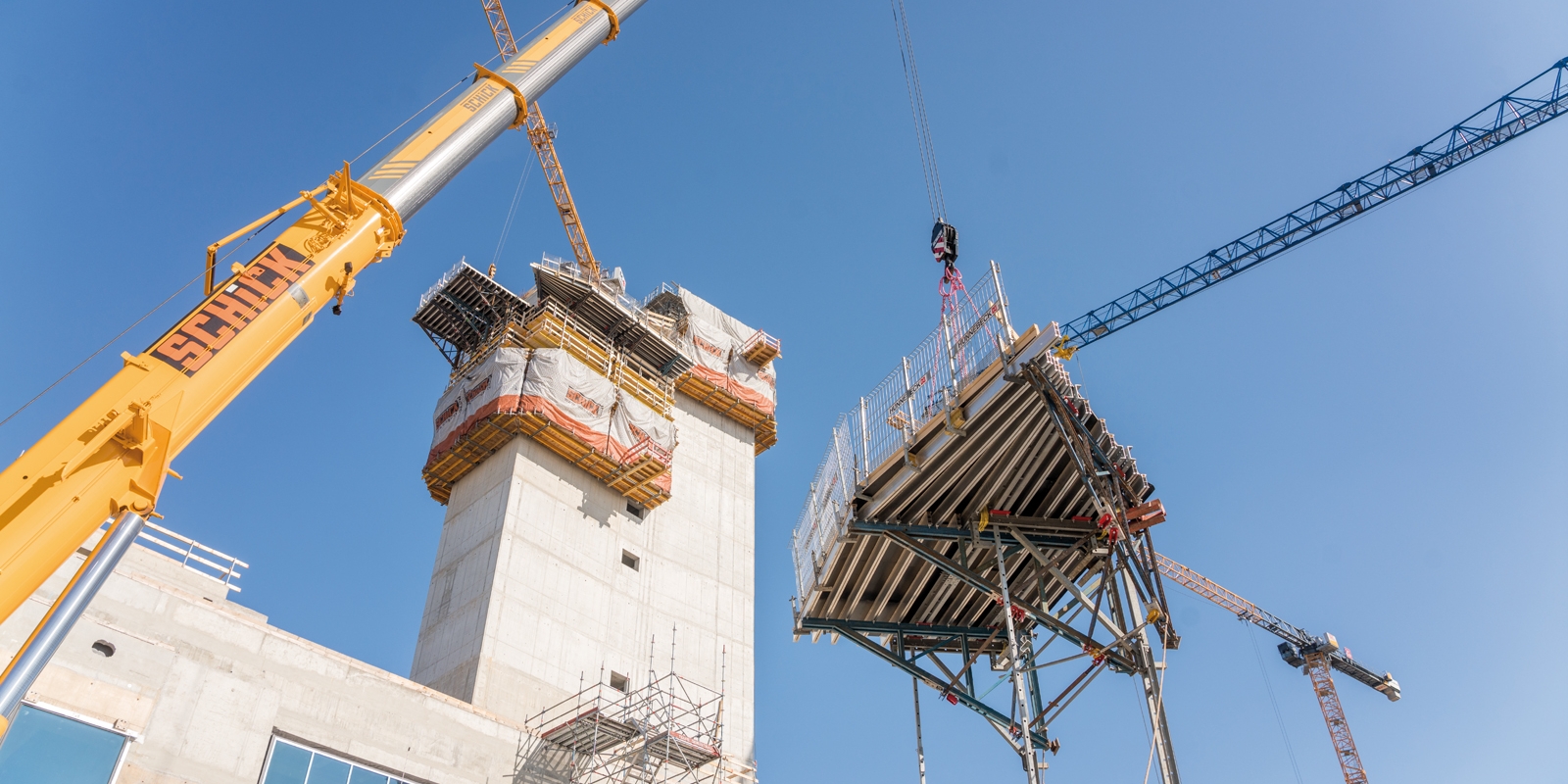


On 22 April 2026, Terminal 3 at Frankfurt Airport was opened on schedule, marking the completion of one of Europe’s largest infrastructure projects. But behind the impressive figures is a story of much more than sheer size – it is the result of precise planning, industrial performance and an exceptional team effort.
Anton Schick GmbH, a HABAU GROUP company, was in charge of the extended shell construction of boarding gates H and J, including the roughly 69-metre-tall apron control tower as well as construction sections 2.1 and 2.2 at gate G. At peak times, up to 350 employees and 15 rotating tower cranes were in use at once. These towered over the construction site and ensured that several sections could be realised simultaneously. Parallel processes were not just coordinated – they were precisely synchronised with one another.
Modular construction meets industrial production
Boarding gates H and J were constructed using modular design: seven i.e. eight identical structural parts were erected simultaneously and joined monolithically after being allowed to set. This procedure enabled the ongoing progress of construction while also maintaining high execution quality.
One decisive success factor was the close cooperation between the construction site and industrial production. The prefab concrete construction at the company’s own plants in Hanau and Bad Kissingen formed the backbone of the shell construction. Numerous constructive elements were produced under controlled conditions at the plant and delivered to the site on a just-in-time basis with the help of the company’s own logistics fleet. There, prefab assembly, in-situ concreting work, formwork and reinforcement activities were seamlessly intermeshed.
Strong internal performance and well-rehearsed structures
From the work preparation to the fleet and prefab concrete plant all the way to the management, all services were provided by a single source. Short communication channels, well-rehearsed teams and the integration of lean management methods made sure that the planning and execution were able to interlock consistently over the years.
Alongside a strong workforce, the technical equipment also played a crucial role. In-house formwork systems, a powerful fleet of trucks, the company’s own mobile cranes, several concrete pumps and a mixing plant directly on site enabled a high degree of independence and flexibility.
The realisation of the shells for boarding gates H and J was a masterpiece of parallel construction processes, technical precision and industrial manufacturing expertise. Terminal 3 demonstrates impressively how modular construction, precise planning and a high level of internal resources come together to create a modern and functional airport terminal.
“The completion of Terminal 3 is a special milestone for us. The fact that we were able to conclude this project on schedule – despite the challenges posed by the COVID pandemic and Ukraine war – fills us with great pride. Following projects such as the winter service building, fire station 3 and the BP sanitary building, we’d like to sincerely thank Fraport AG for once again placing their trust in our performance capability. A construction project of this magnitude can only be implemented with an exceptional level of dedication. Which is why we’d also like to give a special thanks to our employees at the construction site, at the prefab concrete plants and in all the supporting areas – from management to work preparation to the mechanical engineering division. With their expertise, their commitment and their team spirit, they contributed decisively towards the success of this major project. We’d also like to thank our suppliers, partners and subcontractors for their trusting and successful cooperation”, say the Anton Schick management, made up of Stefan Falkenberg, Edgar Endres and Markus Schmitt.