
Bavaria’s biggest modernisation project: HABAU GROUP, PORR and FELBERMAYR to renovate Kachlet lock in Passau
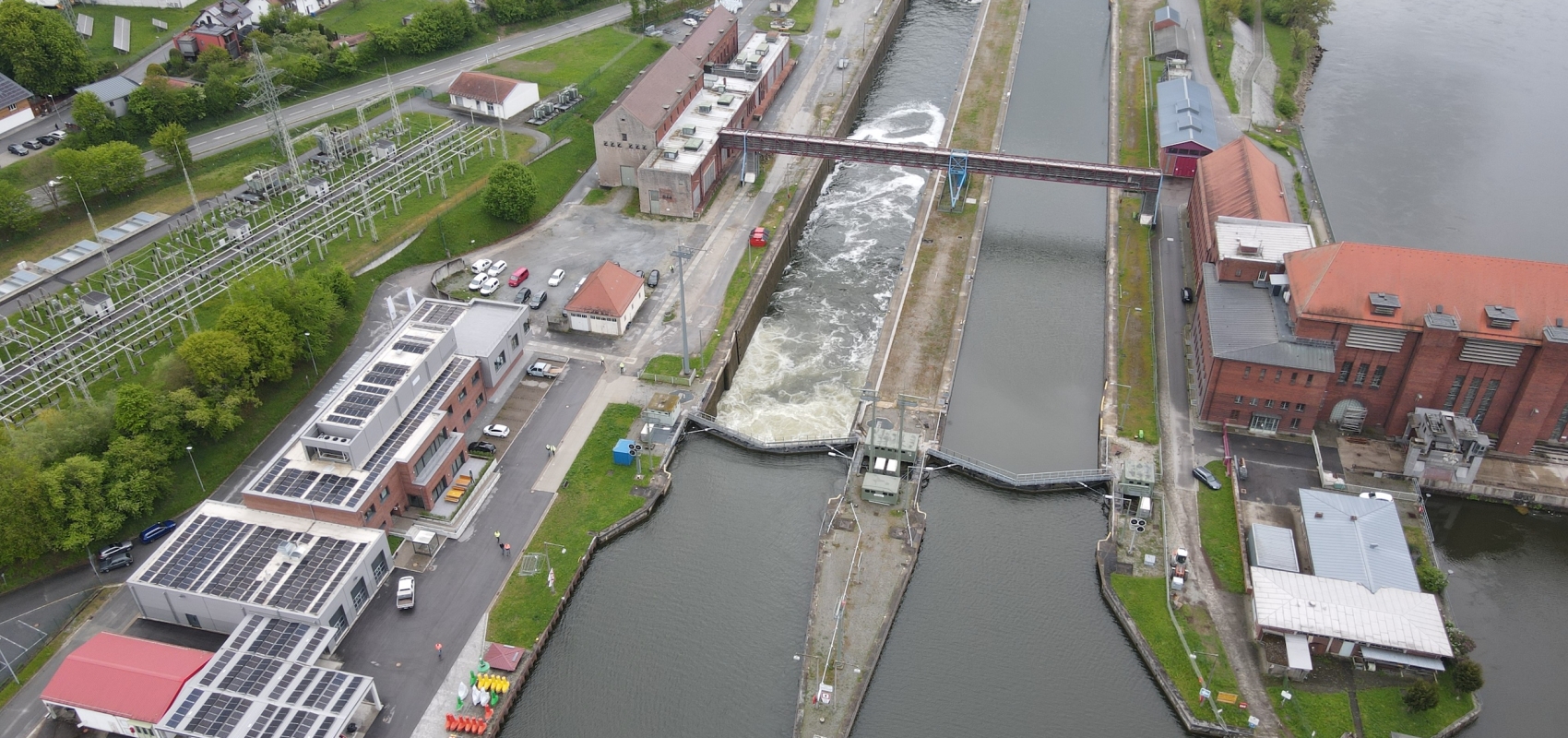

Since 1927, the Kachlet Danube barrage with its double-chamber lock and hydropower plant has been an indispensable part of Passau, Bavaria. Kachlet is considered essential for European freight transport, with around 10,000 ships passing through each year. Almost 100 years after it was built, the time for a complete overhaul has now come.
In an open tender procedure, one of the largest modernisation and total renovation measures at the Main-Danube waterway was awarded to a consortium consisting of HABAU GROUP, PORR and FELBERMAYR. Commissioned by the Waterways Construction Authority of Magdeburg, the three companies will completely overhaul both existing lock chambers one after another over a period of 13 years, starting with the southern lock. During renovation work to the southern lock, traffic will be rerouted to the northern lock, and vice versa.
“The general overhaul of the Kachlet lock is a large-scale project of incredible engineering complexity”, states HABAU GROUP CEO Hubert Wetschnig. “The work requires the utmost precision in both planning and execution. For this, HABAU is contributing its proven expertise in civil and hydraulic engineering, collaborating with its consortium partners to realise infrastructure for the Danube that is safe and efficient in the long term.”
An assignment of special dimensions
This is a large-scale project in every sense of the word: the final expansion of each lock will be around 335 metres long and 24 metres wide. Construction will involve a plethora of building services, from demolition and earthworks to concrete and pipeline construction and hydraulic steelwork. Up to 100 employees will be actively working at the site.
The measure encompasses both lock chambers – southern and northern – including the upper and lower heads for each. The existing structures will be dismantled down to the base level and subsequently entirely rebuilt according to the current technical standards. A further component of the project is the installation of state-of-the-art lock gate technology with new mitre gates and hydraulic drives. The aim is to considerably increase operating safety, adapt the system to present-day shipping requirements and ensure its functional capacity in the long run. In addition, the outer walls of the lock chambers will be torn down using a water drawdown integral pressure procedure, re-anchored and furnished with a new facing layer.
Complex demands – strong partners
The project is associated with a slew of challenging framework conditions. Throughout the entire construction phase, shipping will be maintained, which will require temporary diversions and the close coordination of all involved. At the same time, the logistics on land and on water present a highly complex challenge, since material deliveries, the moving of equipment and construction processes will need to be precisely coordinated. This is compounded by the high demands of the subsoil and water retention, making careful planning and implementation necessary.
In the consortium, HABAU GROUP, PORR and FELBERMAYR combine their respective core competences for optimum project implementation. HABAU GROUP will assume the central engineering services in waterway construction and bring its proven concrete technology, innovative construction procedures and structured work preparation and project coordination to the table. PORR augments the range of services in particular with its extensive expertise in special foundation, civil and earth engineering, while FELBERMAYR adds its many years of experience in hydraulic engineering and lifting technology. The tight-knit synergy of all partners forms the foundation for the technically advanced and on-time implementation of the project.
Long-lasting learning effects beyond the project
Beyond the structural implementation, the project provides a major impetus for the continued development of digital processes. The complete planning in a three-dimensional environment and the use of Building Information Modelling (BIM) enable the early identification of interfaces and potential collisions between the different trades while also supporting the coordinated, economic execution of the project. Moreover, continuous IT-supported process management – including consortium cost estimation in iTWO – ensures transparent, structured processes throughout the entire, extended construction period. The close interdisciplinary cooperation of all parties involved also creates valuable “listen-and-learn” effects from which practical insights for future large-scale projects can be gained.
The construction start of the project is January 2026. In the initial phase of construction, the southern lock will be erected from 2026 to 2033, followed by the realisation of the northern lock from 2033 to 2038. With the completion of both sections, the overall commissioning of the system is scheduled for the year 2038.